
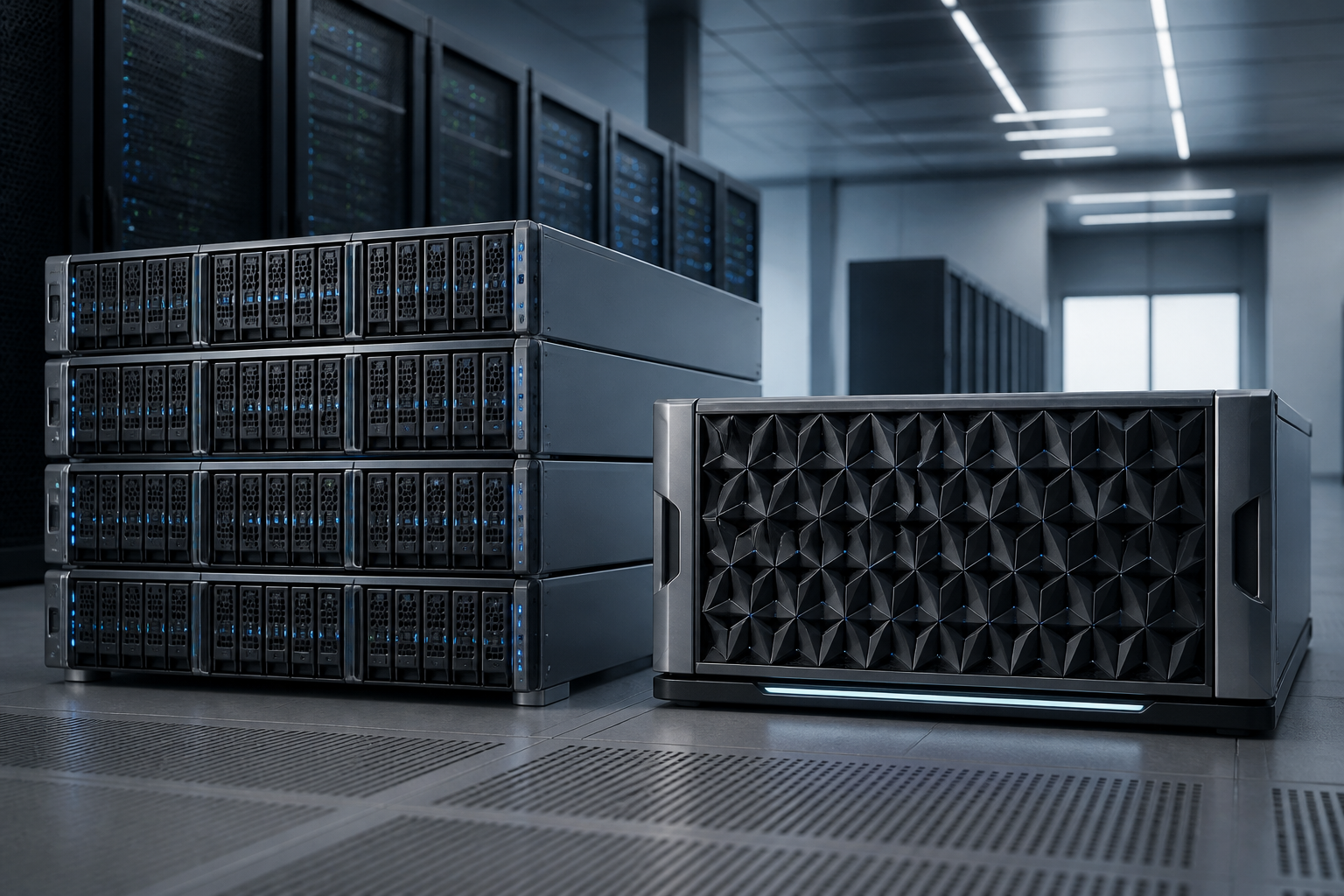
When people ask about HPE Alletra MP vs Dell PowerStore, the real question is usually not “which array is faster?” It is whether you want a storage platform that is optimised around HPE’s disaggregated, cloud-managed model, or a Dell platform that is deliberately broad in protocol support, packaging and day-to-day operational familiarity. The practical differences matter most once you move beyond a single proof-of-concept and start asking about host connectivity, expansion, support cadence, automation and how much complexity your team is prepared to own.
My short version: choose HPE Alletra MP if you are buying into HPE’s GreenLake-led operational model, want disaggregated scale and are comfortable with a platform that is clearly aimed at mission-critical block and file consolidation. Choose Dell PowerStore if you want a mature all-NVMe platform with broad protocol support, a very explicit focus on unified block/file/vVols workloads, and a purchase model that tends to be easier to explain to mixed infrastructure teams. Neither is a casual choice; both are serious midrange-to-enterprise arrays, but they are not identical bets.
That distinction matters because both vendors are now leaning hard into “simplify operations” messaging, but in different ways. HPE positions Alletra Storage MP B10000 as a disaggregated, scale-out block and file platform managed through GreenLake/Data Services Cloud Console, with independent scaling of performance and capacity and protocol support that includes FC, NVMe/FC, NVMe/TCP and iSCSI. Dell positions PowerStore as an all-flash, all-NVMe appliance with unified support for block, file, vVols and container-based workloads, plus FC, NVMe/FC, iSCSI and NVMe/TCP on the front end. (hpe.com)
What has changed, and why this comparison is worth making now
The 2026 version of this conversation is different from the one storage teams would have had a few years ago. HPE’s Alletra Storage MP B10000 line is now explicitly framed around a newer switched 2-, 3- and 4-controller-node architecture, switchless variants, granular SSD and JBOF expansion, and AI-driven reporting in Data Ops Manager. Dell, meanwhile, is pushing PowerStore through a current 4.4 code line, with updated documentation, a 2026 release cadence and continuing support for local and remote protection, metro replication and broad ecosystem integrations. Those are not just product refresh notes; they affect how you should think about lifecycle, support process and platform confidence. (hpe.com)
For UK and Channel Islands buyers, the more useful question is often whether you are standardising on an operating model rather than a brand. HPE’s messaging increasingly assumes an organisation that is comfortable with cloud-style control planes and a more explicit platform abstraction. Dell’s message remains closer to the classic enterprise storage buying pattern: a familiar array, well-documented deployment steps, and a strong emphasis on management, integration and serviceability. Neither is wrong. But they lead to different buying instincts in real IT departments.
| Decision point | HPE Alletra MP | Dell PowerStore |
|---|---|---|
| Operating model | GreenLake / Data Services Cloud Console, disaggregated scale-out framing | Array-centric management with PowerStore Manager, CLI and REST API |
| Protocol breadth | FC, NVMe/FC, NVMe/TCP, iSCSI | FC, NVMe/FC, iSCSI, NVMe/TCP |
| Workload scope | Mission-critical block and file consolidation, with strong emphasis on scale and resilience | Block, file, vVols and container-based workloads in one platform |
| Expansion philosophy | Independent scaling of performance and capacity; more explicit disaggregation | Traditional appliance-style expansion with a broad feature set built into the platform |
| Operational feel | Cloud-managed, policy-led, HPE ecosystem dependent | More conventional storage administration, with a strong documentation and integration footprint |
Verified facts that should anchor the decision
On HPE’s side, the current B10000 QuickSpecs describe Alletra Storage MP B10000 as mission-critical storage at midrange economics, built on HPE Alletra Storage MP hardware and managed via GreenLake. HPE also states support for Fibre Channel, NVMe-oF/FC, NVMe-oF/TCP and iSCSI, and says the platform scales performance and capacity independently without disruption. The same current QuickSpecs also describe a new switchless 4-node configuration and a 100% data availability guarantee for the program. (hpe.com)
On Dell’s side, the current PowerStore product page describes the system as an all-flash, all-NVMe storage appliance with unified support for block, file, vVols and container-based workloads. Dell lists block connectivity as FC, NVMe/FC, iSCSI and NVMe/TCP, file protocols including NFS and SMB variants, and says all software required to store data and manage the appliance is included with purchase. The same current materials show non-disruptive upgrades and a broad data-protection feature set, including immutable snapshots and metro replication. (dell.com)
Both platforms now sit squarely in the “modern enterprise storage” category. The differences are therefore less about whether either is capable, and more about what kind of operational life you want to live with after installation.
Good: choose the platform that best matches your current operating model
Good: HPE Alletra MP
This is the sensible choice if your organisation is already aligned to HPE GreenLake, values independent scaling of performance and capacity, and wants a platform aimed directly at mission-critical block and file consolidation. It is the cleaner fit when you expect the storage team to work through a cloud-style control plane and you are comfortable with HPE’s ecosystem and support motion. That is especially true if you are consolidating mixed workloads onto a single storage fabric and do not want to manage separate islands of file and block infrastructure. (hpe.com)
Trade-off: you are buying into a more opinionated platform story. If your team wants a classic array admin model, or if your broader storage estate is already standardised around Dell tooling, HPE may feel like a bigger operational shift than the hardware spec sheet suggests.
Good: Dell PowerStore
This is the lower-friction option for many enterprise teams because it looks and behaves like a very complete, very familiar storage appliance. It supports block, file, vVols and container-based workloads, offers a broad protocol set, and includes management, upgrade and protection tooling in the box. If your environment is VMware-heavy, mixed-protocol, and run by a team that still expects a conventional array lifecycle, PowerStore is often the easier internal sell. (dell.com)
Trade-off: PowerStore’s strengths are breadth and operational familiarity, not radical architectural separation. If your buying rationale is specifically about disaggregated scaling or a more explicitly cloud-managed model, HPE’s proposition is more pointed.
In other words, the “good” tier is not about being cheap. It is about avoiding a platform change you do not need. If you have a stable virtualisation estate, a sane backup posture and no pressing reason to redesign storage operations, I would start with the array that most naturally fits the team you already have.
Better: step up when the workload mix is getting awkward
The “better” choice is the one that solves the uncomfortable middle ground: you are no longer just serving VM datastores, but you are not yet ready for a separate file platform, a separate SAN refresh and a separate container storage conversation. This is where Dell’s unified support for block, file, vVols and container-based workloads becomes strategically attractive. PowerStore’s published ecosystem list also includes VMware integrations, CSI, Ansible, Terraform and OpenStack Cinder, which makes it easier to see as part of a wider automation story rather than a box in a rack. (dell.com)
HPE’s “better” case is different. Alletra MP’s argument is that independent scaling and cloud-managed operations matter when the environment is getting serious enough that over-provisioning for one workload to satisfy another is starting to hurt. If your business is running consolidation projects, database platforms or mixed mission-critical workloads with a hard performance ceiling, the disaggregated model can be more compelling than a traditional appliance. That is not vendor poetry; it is a real infrastructure judgement about whether you pay for headroom you cannot use, or for a platform whose scaling model better matches your demand curve. (hpe.com)
My practical view is that this tier is where many buyers will end up if they are being honest with themselves: they need more than entry-level all-flash simplicity, but they do not need to make storage architecture their next hobby. Here the tie-breaker is usually not performance marketing. It is whether your team wants a more cloud-managed operating model or a more conventional array with a very broad feature map.
My view: if your storage team is small, your virtualisation estate is large, and your infrastructure colleagues want one platform to cover block, file and vVols without constantly opening new architectural debates, PowerStore is usually the simpler social choice. If your organisation is already moving towards managed services, platform abstraction and independently scalable infrastructure, Alletra MP is the more intellectually coherent bet. The important point is that this is mostly an operating-model decision pretending to be a hardware one.
Best: choose based on the risks you cannot tolerate
At the “best” level, I stop asking which system has the nicer spec sheet and start asking which risk you are trying to remove from the organisation. If the risk is operational sprawl — too many storage silos, too many tools, too many one-off exceptions — then Dell PowerStore has a strong case because it is a broad, unified platform with mature documentation and a clearly articulated management stack. It gives you one place to handle block, file, vVols and associated protection features without forcing a larger cloud-consumption conversation. (dell.com)
If the risk is that your storage infrastructure is becoming too tightly coupled to legacy capacity planning, then HPE Alletra MP is the more ambitious answer. HPE’s current materials are explicit about disaggregation, independent scaling and AI-driven reporting through Data Ops Manager. That combination matters when the storage platform is expected to support more dynamic workload placement, tighter performance troubleshooting and less guesswork in capacity planning. (hpe.com)
That said, “best” is not always the system with the cleanest story. It is the system your team can actually operate well under pressure. A platform that looks elegant in a procurement deck but asks for a different commercial model, different telemetry habits and different support expectations may be the wrong answer if your organisation is not ready for it. Conversely, a more familiar array may be operationally safer even if it is not the most strategically elegant. This is where procurement folklore usually gets in the way of good engineering judgement.
Where the vendor framing is useful — and where it is not
HPE’s language around “disaggregated scale-out” is useful because it points to a real architectural choice: whether performance and capacity should be bought and scaled together. That is a material issue in enterprise storage, particularly for mixed workloads. But the marketing gloss can overstate how often teams need that flexibility, so I would not buy Alletra MP purely because the phrase sounds modern. Buy it because your workload profile genuinely benefits from independent scaling and you are comfortable with the operational stack that comes with it. (hpe.com)
Dell’s framing is useful in a different way. PowerStore’s “all-NVMe” and “unified support” claims are grounded in a product that clearly spans multiple protocol and workload types. That breadth is valuable. The trap is assuming breadth automatically means architectural advantage. It does not. It means fewer reasons to split your environment. That is good, but only if the platform’s scale, management and service model suit your team’s operating rhythm. (dell.com)
In both cases, the marketing story is strongest where it aligns with actual operational consequences. It is weakest when it implies there is a single obvious winner. There is not.
Practical recommendation
If I were choosing for a typical UK enterprise with a small but capable infrastructure team, I would decide this way:
- Choose Dell PowerStore if you want the most straightforward route to a unified block, file and vVols platform with broad automation and integration options, and you value a traditional storage operating model that your team can adopt quickly. (dell.com)
- Choose HPE Alletra MP if you are standardising around HPE GreenLake, want a disaggregated platform that can scale performance and capacity separately, and are prepared to embrace a more cloud-managed storage operating model. (hpe.com)
- Do not buy either if your main problem is actually backup immaturity, VMware licensing pain, or a lack of storage governance. Arrays do not fix process debt; they just make it more expensive.
For readers who are in the middle of a broader platform review, this comparison also sits neatly alongside our wider coverage of storage and virtualisation transition planning. If you are thinking about the infrastructure ripple effects of a storage refresh, our pieces on Understanding HPE Alletra MP – A Comprehensive Overview, HPE Alletra MP in the Real World: Performance and Insights and VMware Exit Strategy: How to Migrate Using HPE VME or Veeam are the natural next reads.
Sources and further reading
HPE Alletra Storage MP B10000 QuickSpecs
HPE Alletra Storage MP – An overview and features of HPE Alletra Storage MP
HPE Alletra Storage MP data sheet
Dell PowerStore All-Flash Storage product page
Dell PowerStore Info Hub: Product Documentation and Videos
Understanding HPE Alletra MP – A Comprehensive Overview
Spot an error?
If something factual looks wrong, outdated or misleading, flag it here. Corrections are reviewed separately from normal article comments and reader questions.