
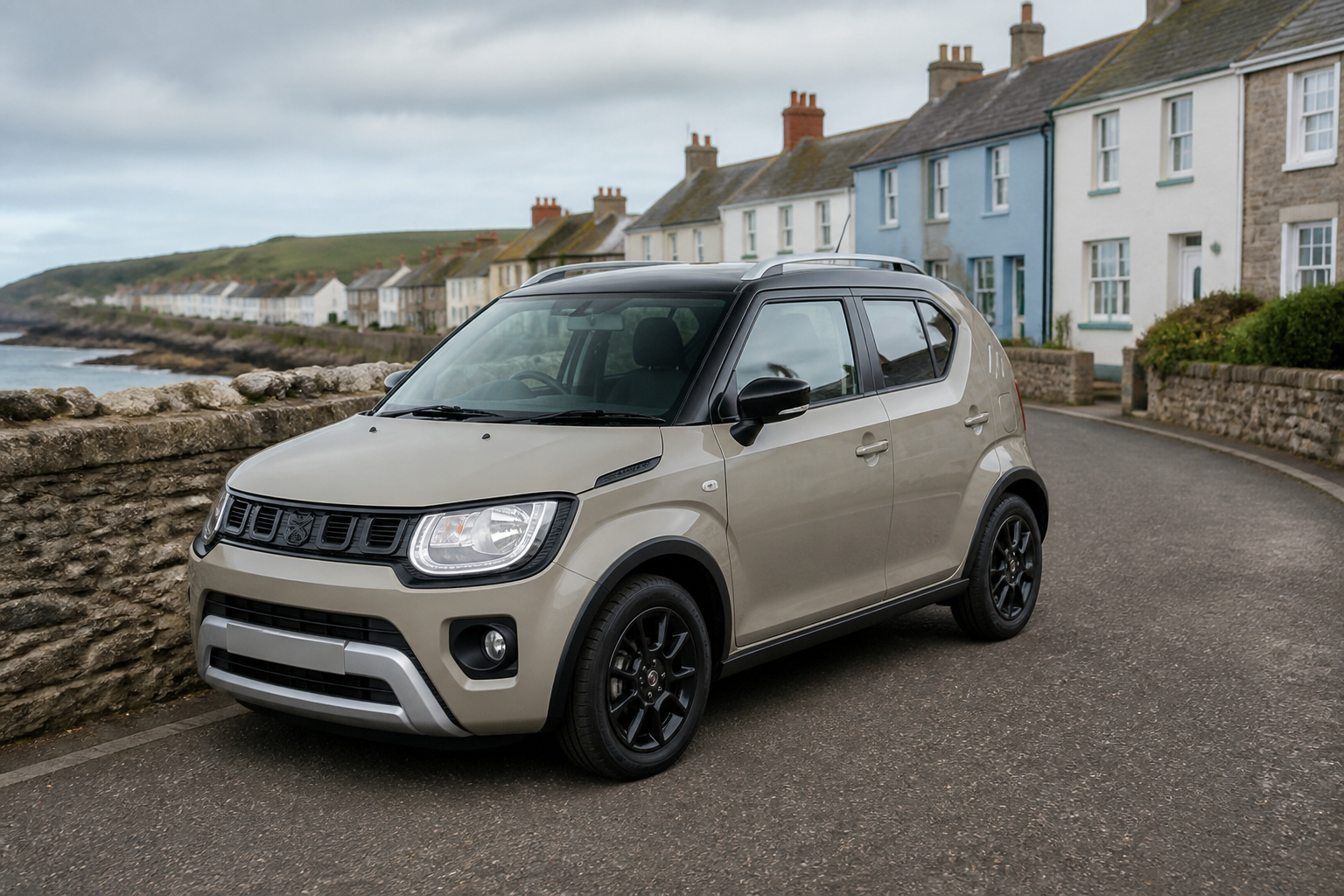
The Suzuki Ignis makes most sense as a used buy for drivers who need an easy-to-park car with genuinely useful cabin space. Its unusual shape, high seating position and compact dimensions give it an appeal that is hard to match at this size.
Suzuki has confirmed that all new Ignis stock in the UK has gone, so the question is no longer which options to order. It’s about finding the right example. For buyers who need a genuinely compact car with a high seating position, excellent all-round visibility and more cabin usefulness than its footprint suggests, the Ignis makes a convincing case. It suits tight towns, island roads, narrow lanes and households that need a car which is easy to park without being utterly joyless.
There are catches. It’s light, narrow and short, so motorway refinement isn’t its strength. The interior is hardy rather than plush, and the rear-seat arrangement on better-equipped versions makes it a four-seater. Nor should the word “hybrid” persuade anyone that it behaves like a Toyota full hybrid: the post-2020 Ignis uses a 12V mild-hybrid system. It assists the petrol engine rather than offering meaningful electric-only running.
What matters is the packaging, not the badge
At 3.7 metres long, the facelifted Ignis is properly small, but its cabin is tall and airy, and the turning circle is notably tight. Suzuki quoted 9.4 metres for the 2020-on car. That matters more than a fashionable driving mode when the daily routine involves multi-storey car parks, tight driveways or squeezing past a delivery van on a Channel Islands lane.
The upright shape pays off in visibility, too. The driver sits higher than in most city cars, with a short bonnet and square ends that make the car easy to place. There’s no need to pretend it’s an SUV; plainly, it isn’t. But it delivers the useful part of the SUV idea — easy entry, a higher eyeline and decent ground clearance — without the bulk and weight that can make small crossovers worse small cars.
The cleverest feature is on SZ-T and SZ5 versions. Their two rear seats slide independently by 165mm and recline, so the owner can favour rear legroom or luggage space. Suzuki listed 267 litres for the fixed-bench SZ3, while the sliding-seat versions have a smaller nominal boot in their rear-most setting but can be arranged around the job at hand. Fold the seats and there’s a surprisingly square, useful load area. The trade-off is simple: SZ-T and SZ5 cars are officially four-seaters, not five.
That makes the Ignis better suited to one or two adults, occasional rear passengers, a dog, shopping or modest DIY runs than to family life with three people routinely across the back. A Honda Jazz remains the more rational compact people-carrier. The Suzuki is the more compact, more characterful answer if rear-centre-seat duty is rare.
The driving experience: light, honest and best at sensible speeds
The recipe is simple: a naturally aspirated 1.2-litre four-cylinder petrol engine and low kerb weight. On the facelifted mild-hybrid model, Suzuki quoted 83PS and 107Nm. That’s not much on paper, but the Ignis doesn’t have much mass to shift. Around town it feels alert enough, and a manual encourages the driver to use the revs rather than wait for a turbocharged surge that isn’t coming.
The five-speed manual is the one to seek if driving satisfaction and mechanical simplicity matter. It suits the car’s light controls and modest power, and avoids the question of whether an automatic’s behaviour suits you.
The CVT is the choice only when automatic convenience is non-negotiable. It’s a proper CVT, not Suzuki’s earlier automated-manual arrangement, and some drivers will value its smoothness in stop-start work. Under firm acceleration, though, it holds the engine at higher revs in the familiar CVT manner. Test it on a hill and at dual-carriageway joining speeds before deciding. It isn’t defective for behaving like a CVT; it simply won’t suit everybody.
On faster roads, the Ignis’s virtues become its limitations. Its low weight and relatively upright body bring more wind and tyre noise than in a larger hatchback, while the short-wheelbase ride can become fidgety on broken surfaces. It will cruise, but regular long-distance motorway drivers should look at a Suzuki Swift, Honda Jazz, Toyota Yaris or a larger conventional hatchback. The Ignis is at its best with corners, roundabouts, town traffic and somewhere awkward to park at the end.
Which used Ignis should you buy?
The straightforward answer is a tidy, serviced manual SZ-T. It gets the useful sliding rear seats, a reversing camera, alloy wheels, roof rails and smartphone connectivity with Apple CarPlay and Android Auto. For most buyers, that’s the sweet spot: enough equipment to make the car easy to live with, without paying SZ5 money for features that may not matter.
An SZ5 is worth seeking if safety equipment is high on the list. On the 2020-on range, Suzuki fitted its Dual Camera Brake Support, lane-departure warning and weaving alert as standard to SZ5, alongside navigation, keyless entry, automatic air conditioning and cruise control. The extra equipment is worthwhile, but condition matters more than the trim badge. A well-kept SZ-T with a clean history is a better buy than a neglected SZ5.
The 2020 facelift brought the K12D 1.2-litre mild-hybrid engine across the range. Suzuki’s official combined figure for the 2WD manual was 55.7mpg under WLTP testing, but treat that as a laboratory comparison figure, not a promise for any particular owner. Its more relevant advantage is that it remains a straightforward petrol car with a compact belt-driven starter-generator and small lithium-ion battery, rather than a complex plug-in system.
Pre-facelift cars aren’t automatically inferior. They retain the same essential appeal, and an earlier 1.2 Dualjet manual with convincing service records can be the value choice. Buy on condition, specification and history; don’t assume a later registration plate always wins.
The rare manual SZ5 ALLGRIP is the enthusiast’s choice, and potentially the right tool for rural buyers. Suzuki’s ALLGRIP AUTO system sends torque rearwards through a viscous coupling when grip is lost; it also brings hill-descent and grip-control functions. It’s useful extra traction for wet grass, steep lanes and winter roads, not permission to take a small hatchback green-laning. It costs space, too: Suzuki quoted 204 litres of luggage capacity for the ALLGRIP against 260 litres for the comparable 2WD sliding-seat layout. Unless that traction solves a real local problem, the front-wheel-drive manual is the cleaner, cheaper answer.
Reliability: an encouraging recipe, but inspect the individual car
The Ignis has a reassuringly uncomplicated mechanical layout by current standards: petrol power, modest outputs, low weight and no diesel emissions equipment. That’s a sound starting point for used ownership. It isn’t evidence that every Ignis will be trouble-free, though, and there is no sufficiently detailed public official dataset to support a definitive list of model-wide “common faults”. Treat dramatic online fault lists accordingly.
What you can check is the car in front of you. Review its MOT record for repetition, not merely the latest pass. Repeated advisories for tyres, brakes, suspension wear, corrosion or headlamp alignment tell a more useful story than a dealer description. The GOV.UK MOT service provides test history, recorded mileage and defect information for vehicles tested in Great Britain.
On a viewing, make these Ignis-specific checks:
- Start it cold. The engine should settle promptly to a clean idle, with no warning lights left illuminated.
- Test every electrical convenience. That means touchscreen, camera, DAB, Bluetooth or smartphone connection, air conditioning, central locking, windows and keyless entry where fitted. A small car can still produce disproportionately irritating bills for neglected electrical niggles.
- Operate the rear seats. On SZ-T and SZ5 versions, check both sliding mechanisms, recline catches and seat folding. They should move and lock properly.
- Listen on rough roads and under braking. A road test should expose suspension knocks, steering vagueness, wheel-bearing noise and pulling under braking.
- Check the tyres carefully. The Ignis’s small size doesn’t make it immune to kerb damage. Uneven wear may point to alignment trouble or neglected suspension work.
- For CVT cars, drive rather than merely manoeuvre. It should engage drive and reverse cleanly, pull away smoothly and not produce unusual shuddering or warning lights.
- For ALLGRIP cars, inspect underneath. Look for damage, corrosion, leaks and evidence that the car has had a harder off-tarmac life than the advert admits.
Check outstanding recall or service-campaign work by registration number or VIN before money changes hands. There is one important Channel Islands wrinkle: Suzuki’s own online recall checker says it is unavailable for vehicles registered in Jersey or Guernsey. Buyers there should ask a Suzuki dealer to confirm the vehicle’s status directly, then retain the answer with the paperwork.
Safety and comfort need realistic expectations
Don’t judge the Ignis by the standards of a 2026 small car. Euro NCAP tested it in 2016, and that rating has expired. The assessment recorded 79% for adult occupant protection and 79% for child occupant protection, but just 25% for safety assist on the standard-equipment car. Crucially, low-speed autonomous emergency braking was associated with the optional Dual Camera Brake Support safety pack and wasn’t included in the standard-car result.
The practical takeaway is simple: if active safety matters, verify the exact equipment on the car you’re considering. Don’t assume every Ignis has autonomous emergency braking because a later advert says “safety pack” or because a newer SZ5 did. Equipment changed across years and grades.
Comfort is specification-dependent, too. The basic cabin is durable and cheerful rather than luxurious. Later, better-trim cars make more sense because the camera, smartphone integration and sliding rear seats materially improve day-to-day life. Don’t pay a premium for decorative personalisation alone; colour inserts and roof graphics won’t make a noisy motorway journey quieter or create a fifth rear seat.
Bottom line
Yes, the Suzuki Ignis is a good used buy in the UK and Channel Islands — provided you want what it actually is. It isn’t a miniature premium SUV, a long-distance hatchback or a five-seat family car. It’s a remarkably compact, refreshingly light and genuinely useful small car with a higher seating position and a little personality.
The best all-round choice is a manual SZ-T. An SZ5 is worth the extra outlay where its safety and comfort equipment is present and working. Choose the CVT only after a proper drive, and choose ALLGRIP because local roads or access genuinely justify it, not because four-wheel drive sounds appealing in an advert.
For buyers tired of cars that keep growing while becoming less distinct, the Ignis has aged well. Its compromises are obvious. So are its virtues.
Spot an error?
If something factual looks wrong, outdated or misleading, flag it here. Corrections are reviewed separately from normal article comments and reader questions.