
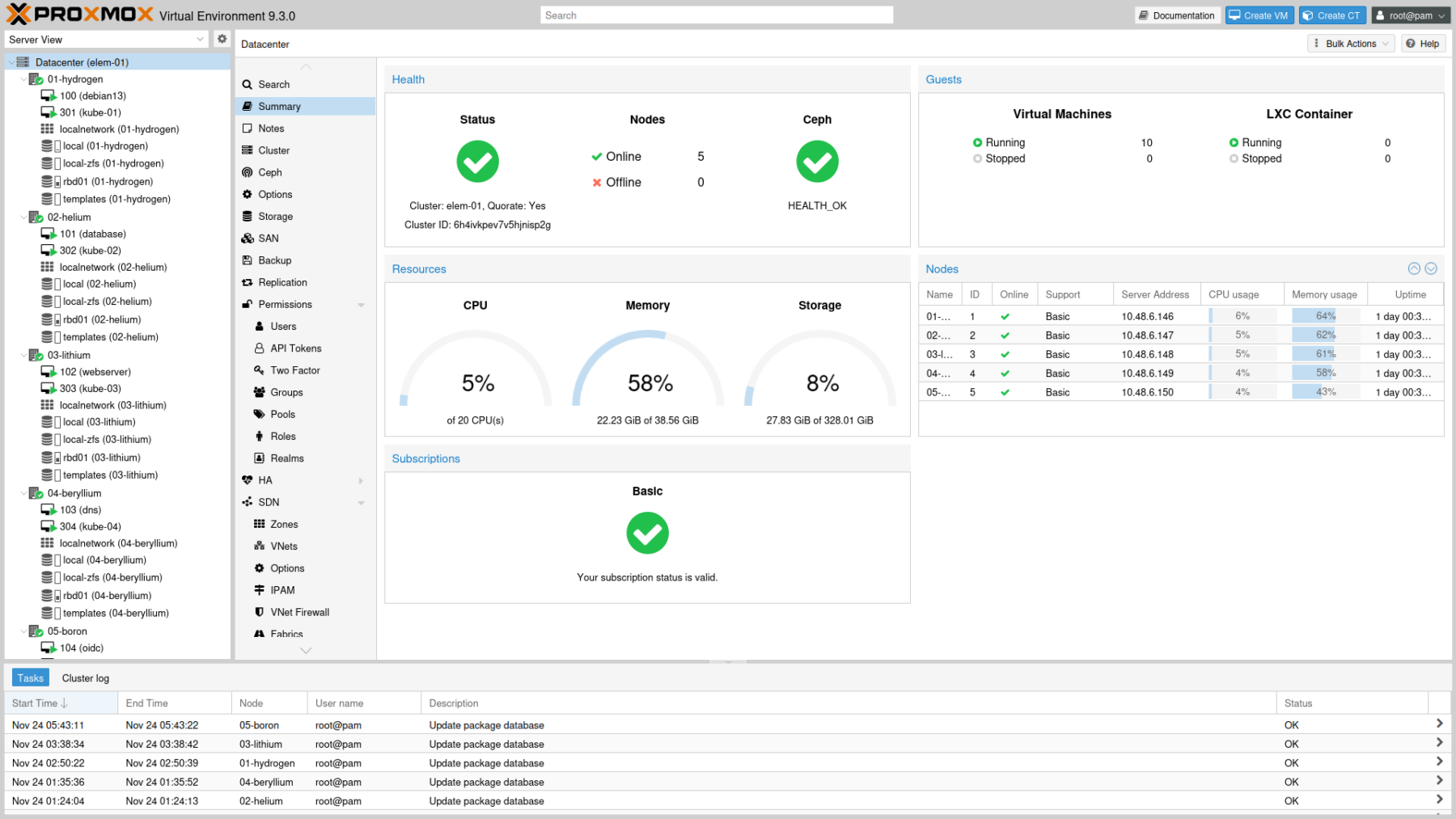
A Proxmox VE subscription is not a conventional software licence fee: it is an operational decision about update confidence and support when a fault matters. The platform keeps the same core capabilities without a subscription, but the cost and value of paid cover rise quickly when several hosts must run as one production cluster.
What a subscription changes is the update channel and, above Community level, access to Proxmox support. For a homelab, that can mean running Proxmox VE at no cost. For a business, the real question is whether the operation needs a more conservative package stream and a defined escalation route when something goes wrong.
The short answer: as checked on 27 November 2026, Proxmox VE subscriptions cost €120, €370, €550 or €1,100 per occupied physical CPU socket per year, before VAT. The software itself remains free and open source at every level.
Proxmox VE subscription prices at a glance
Proxmox charges annually, in euros, per occupied physical processor socket. It isn’t priced per virtual machine, virtual CPU, core, user or cluster. A single-socket server with a 64-core processor needs one subscription; a dual-socket host needs two. These are net prices, so VAT or other applicable local tax is extra.
| Subscription | Net annual price | What it principally adds | Best fit |
|---|---|---|---|
| Community | €120 per socket | Enterprise Repository access; no Proxmox support tickets | Homelabs, training, evaluation and non-critical systems |
| Basic | €370 per socket | Enterprise Repository, three tickets per year and a one-business-day response target | Small production estates with modest support needs |
| Standard | €550 per socket | Enterprise Repository, ten tickets per year, remote Secure Shell (SSH) support and a four-hour critical-case first-response target | Established production operations |
| Premium | €1,100 per socket | Enterprise Repository, unlimited tickets, remote SSH support and a two-hour critical-case first-response target | Business-critical workloads where 24/7 vendor coverage is required |
These are recurring one-year subscriptions, not perpetual software licences. Budget accordingly: the relevant number is the total populated socket count across the hosts you intend to cover.
How the per-socket calculation works
The rule is simple, but easy to misread. A subscription key is tied to a server, and each physical host needs coverage for its occupied socket count. Four one-socket servers therefore need four one-socket subscriptions; they don’t share a single four-socket entitlement.
Clusters add another constraint: every node in a Proxmox VE cluster must be on the same subscription tier. You can’t put two production nodes on Standard and leave a third on Community. A three-node cluster of one-socket hosts costs €360 a year net on Community, €1,110 on Basic, €1,650 on Standard or €3,300 on Premium.
Socket pricing can favour modern single-socket hardware. A host with many cores doesn’t cost more simply because it can run more virtual machines. The other side of that calculation is that an older dual-socket server bought cheaply may cost more to subscribe than expected.
What paying changes — and what it doesn’t
Every Proxmox VE feature remains available without a subscription: KVM (Kernel-based Virtual Machine) virtual machines, LXC (Linux Containers) containers, clustering, HA, live migration, storage integrations, the firewall, backup functions and the web interface. There is no cut-down free edition with artificial VM limits waiting to catch a growing deployment.
The meaningful operational difference is the package repository, the source from which system packages and updates are installed. Subscribers receive the Enterprise Repository, which Proxmox describes as its most stable package stream and suitable for production. Unsubscribed installations can use the no-subscription repository without a key. Proxmox says that channel is intended for testing and non-production use because packages aren’t always as heavily tested and validated before release.
An unsubscribed server still receives updates, and the paid repository isn’t a substitute for competent administration. The subscription buys a more conservative package channel and, at Basic, Standard and Premium, a defined route to escalate a problem to the supplier. Patch discipline, rollback plans, reliable backups and recovery exercises still sit with the operator.
Proxmox VE subscription cover is separate from backup cover. A Proxmox VE subscription doesn’t include a subscription for Proxmox Backup Server, despite the close integration. Proxmox Backup Server is separate because of its backup architecture and restore workflow, not because of a hidden entitlement bundled with the hypervisor subscription.
Which Proxmox VE subscription should you choose?
Homelab, learning and personal projects: free, or Community if you value the repository
For a home server, lab or learning setup, start free. The core platform is the same, and paying solely to remove the subscription notice from the interface makes little sense.
Community suits anyone who wants Enterprise Repository access for a modest annual cost but doesn’t need a contractual support route. At €120 per socket per year, it can be easier to justify for a serious home lab or non-critical professional test environment than Basic. It isn’t technical support, though: help remains community-based.
Test and development systems: free can be appropriate, but be deliberate
A non-production estate doesn’t automatically need a subscription. The no-subscription repository has a legitimate role when a team is evaluating Proxmox VE or testing changes before promotion. The danger is letting “test” become a loose label for systems that quietly carry customer data, internal applications or the only working copy of a service.
If a development cluster is close enough to production that an outage would disrupt the business, Community or Basic can be a reasonable way to standardise repository use. Whether it needs paid vendor support depends on the team’s capability and the consequences of a difficult fault, not on whether someone calls it dev.
Small business production: Basic is a floor, not an automatic recommendation
Basic provides three tickets annually and a one-business-day response target. That may be enough for a small, technically capable organisation with a straightforward estate, a good support partner and services that can tolerate a wait. It’s a poor fit if a failed host could stop core operations and the business expects the platform vendor to engage quickly.
At only €180 more per socket each year than Basic, Standard may be easier to justify where direct Proxmox support is part of the operating model. It provides ten tickets, remote SSH support and a four-hour first-response target for a Severity 1 case, Proxmox’s critical incident category. That is a first-response target, not a promise that a complex incident will be fixed within four hours. Keep that distinction in any approval paper.
Critical systems: Premium only where the response commitment is genuinely needed
Premium adds unlimited tickets and a two-hour Severity 1 first-response target. Proxmox says Premium includes 24/7 ticket support from 19 October 2026. This is the tier for services whose outage has immediate and material consequences, or where contractual, audit or governance requirements demand an around-the-clock vendor route.
Don’t buy it simply because “production” sounds important. A well-run internal system with clear maintenance windows, tested restores and experienced administrators may be properly served by Standard. A small cluster supporting a service with tight recovery commitments, meanwhile, may justify Premium despite its size.
Before you buy: count populated physical sockets, not cores; make sure every cluster node can use the same tier; and document the impact of a host failure. If those answers don’t justify a support escalation route, a higher plan is probably expensive reassurance.
The support-hours detail that buyers shouldn’t gloss over
Support plan labels can look clearer than their operational reality. Proxmox defines its advertised response targets around critical Severity 1 requests submitted through the Customer Portal. For customers outside North America and APAC (Asia-Pacific), its published business-hours arrangement is Monday to Friday, 07:00–17:00 CET/CEST on Austrian business days. Premium’s 24/7 coverage is already live; Proxmox says Standard is due to move to 24/7 support by the end of 2026.
That last point is time-sensitive. As of 27 November 2026, a buyer needing round-the-clock support shouldn’t assume Standard already provides it because the published change is close. Confirm the applicable coverage at purchase, especially where services span time zones or Channel Islands support expectations are tied to a local contract or managed-service provider.
Subscription cost is not the whole Proxmox cost
Proxmox’s per-socket pricing is straightforward, but it can still lead to the wrong decision if treated as the whole financial case. Resilient storage, replacement hardware, networking, monitoring, backup retention and the staff time needed to run a virtualisation platform competently may cost more. That is especially true with a cluster: three hosts aren’t resilient merely because they’ve been joined together. Quorum, the number of nodes required for a cluster to make decisions safely, shared or replicated storage, maintenance processes and failure testing determine whether losing a node is survivable in practice.
What Proxmox VE really costs to run covers the wider operating cost. Organisations planning a three-node design also need to understand the operational conditions behind surviving node loss; a subscription decision is not an availability strategy.
Bottom line
Proxmox VE is free software, with its major virtualisation features available without a paid subscription. Paid plans are annual, socket-based subscriptions for a more conservative repository channel and, beyond Community, vendor support.
Use the free route for learning and genuinely non-critical work. Community is a suitable choice for labs that want Enterprise Repository access without vendor tickets. For business workloads, choose Basic only when three tickets and a one-business-day response genuinely match the risk. Standard may suit operations where Proxmox support is part of production operations; Premium is for workloads where a 24/7, two-hour critical-response commitment has a clear business case.
Sources and further reading
Spot an error?
If something factual looks wrong, outdated or misleading, flag it here. Corrections are reviewed separately from normal article comments and reader questions.